The Polynesian Pareo: History, Authenticity, and Manufacturing Secrets
Table of Contents
- The origins of clothing in Polynesia – before the pareo
- The birth of the Polynesian pareo
- Why there is no real textile industry in French Polynesia
- How to spot a genuine Polynesian pareo
- The secrets of artisanal production
- How to wear a pareo the Polynesian way
- The pareo today – a symbol under threat
When you arrive in Tahiti or one of the paradise islands of French Polynesia, the pareo stands out as the textile emblem par excellence. Colorful, lightweight, endlessly versatile, it embodies the easygoing ocean life all by itself. Anyone who spends time on the islands quickly notices how fabric becomes part of daily life – not as a “souvenir” idea, but as something worn, folded, washed, tied, and reused. That practical side is exactly why hand-painted pareos are still talked about with a kind of respect: they’re not just pretty, they’re meant to live with you. But do you really know its story? Did you know that behind those floral motifs lies a complex – and sometimes unsettling – economic reality? Let’s dive into the fascinating world of this iconic fabric.
The origins of clothing in Polynesia – before the pareo
Let’s rewind time, long before the first European navigators set foot on these islands. Ancient Polynesians did not know the pareo as we picture it today. Their traditional wardrobe was disarmingly simple – perfectly adapted to the tropical climate and their way of life.
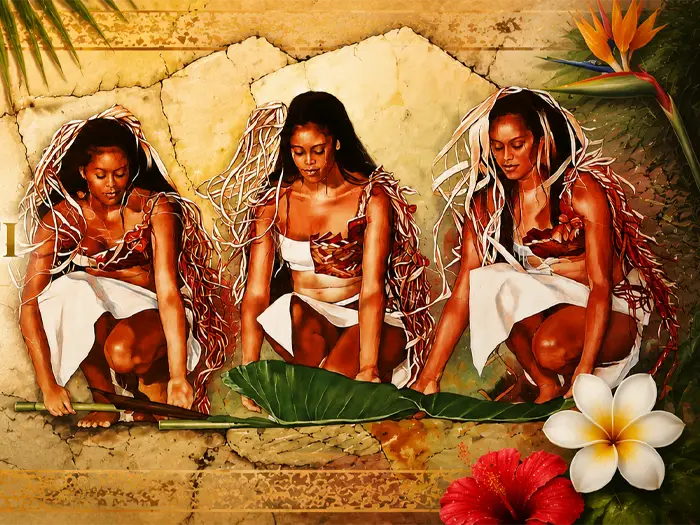
Tapa, or “ahu”, was the original garment worn by people across the Pacific islands. This plant-based cloth, made from the bark of the paper mulberry (locally called “aute”), required ancestral know-how passed down from generation to generation. Women spent hours beating moistened bark on large flat stones until it became a supple, durable material.
Men generally wore a simple loincloth tied at the waist, the maro, while women wrapped themselves in larger tapa pieces. These garments were anything but crude: decorated with geometric patterns made with natural pigments, they reflected social rank and tribal belonging. Chiefs wore finely crafted tapas – true portable works of art.
That “portable art” idea is still a thread you can follow today: symbols travel, patterns travel, materials travel. It’s one of the reasons Polynesian art often feels connected to everyday life rather than locked in a museum vibe.
Partial nudity was not shocking in a society where the body was celebrated and respected. Tattoos, far more than clothing, marked identity and status.
The birth of the Polynesian pareo
The arrival of Europeans in the 18th century completely reshaped Polynesian dress. Missionaries, scandalized by what they saw as clear indecency, gradually imposed more “decent” clothing according to Western standards.
It was in this context of cultural encounter that the modern pareo appeared. The word itself likely comes from the Tahitian “pāreu”, originally meaning any piece of fabric wrapped around the body. European traders began importing printed cotton – a material previously unknown in the islands.
Polynesians, with their legendary creative instinct, quickly made these colorful fabrics their own. They saw a practical alternative to tapa, whose production demanded intense labor. The pareo became the perfect bridge between tradition and modernity: it preserved the ancient draped-garment principle while adopting manufactured textiles from elsewhere.
Over the decades, local artisans developed their own aesthetic. Floral patterns inspired by lush island vegetation – hibiscus, tiaré flowers, frangipani – replaced tapa’s geometries. Bright colors echoed lagoon sunsets, the ocean’s turquoise hues, and the deep green of the mountains. If you pay attention, you’ll see the same color instincts in objects people keep around the house, especially in Polynesian decor.
Why there is no real textile industry in French Polynesia
Here is likely the least-known truth about the Polynesian pareo: there is virtually no textile industry worthy of the name in French Polynesia. This surprising reality challenges the romantic image many people have of these colorful fabrics.
The numbers speak for themselves: about 9 out of 10 pareos sold as “Polynesian” are actually made in Indonesia, or even China. Why? Pure economics and logistics. French Polynesia simply does not have the infrastructure to produce fabric at scale. No spinning mills, no weaving factories, no industrial dyeing facilities.
Now imagine what it would take to set up a real textile plant on remote islands. The costs would be astronomical. But there is an even bigger issue: the textile industry is among the most polluting industries in the world. Mass dyeing processes that create vibrant, long-lasting colors generate huge volumes of wastewater loaded with chemicals.
In an ecosystem as fragile as Polynesia’s, where each lagoon is a biodiversity treasure, it would be virtually impossible to treat that pollution properly. The required water-treatment systems would cost a fortune and could still end up contaminating the crystal-clear waters that define these islands’ beauty and wealth.
The direct consequence: no mass-dyed fabric can be produced locally. This technique, standard across the global textile industry, remains out of reach for the few artisans who still keep the authentic pareo tradition alive.
Because yes, there are a handful of small makers in the territory. These passionate artisans work the old way, painting their motifs by hand onto blank fabric. But their output remains confidential – almost purely artisanal. With around 270,000 tourists arriving each year in French Polynesia, these family workshops obviously cannot meet demand. Even if not every visitor buys a pareo, genuinely local supply is a drop in the ocean of the tourist market.
How to spot a genuine Polynesian pareo
So how do you tell the difference between an imported pareo and a truly local, authentic creation? The secret lies in the fabric itself and the decoration technique.
Real hand-painted Polynesian pareos almost always use cotton voile. Light and airy, it feels incomparable against the skin. It lets the body breathe in tropical heat while keeping a natural elegance. When you run your fingers over cotton voile, you immediately notice its fineness – that slightly irregular texture that gives away authenticity.
Pareos imported from China or Indonesia, on the other hand, usually use thicker cotton, sometimes synthetic blends. The fabric is mass-dyed in factories, producing uniform colors that look almost too perfect. The patterns are mechanically printed with mathematical precision.
On an authentic Polynesian pareo, you will see slight variations in tone, tiny imperfections that sign human work. Each piece is unique, even when the motif repeats from one pareo to another. Hand-applied textile paint creates subtle nuances, nearly imperceptible gradients that bring the fabric to life.
Look closely at the edges of the pattern: on an industrial pareo, they will be crisp like a scalpel cut. On a hand-painted piece, you will see micro-variations, slightly soft borders that reveal the brush or stamp.
The secrets of artisanal production
The rare artisans who preserve the tradition of hand-painted pareos are guardians of a precious craft. Their creative process demands patience, precision, and artistic sensitivity.
It starts with choosing cotton voile, imported in blank rolls. The fabric is carefully prepared and stretched on large worktables. Artisans create their stencils or ready their brushes depending on the style. Some use wooden carved stamps – a technique that echoes old tapa motifs in a surprising way. Those carved forms also explain why certain iconic shapes keep resurfacing, like what you see in tiki art.
Textile paints are mixed carefully to achieve the exact shade desired. No room for mistakes: once applied, the color is final. Every gesture matters, every brush pressure must be controlled so pigment penetrates the fabric without saturating it.
Drying takes several hours. Then comes setting the dye, often with steam or high-heat ironing, ensuring durability even after many washes. Finally, hems are sewn by hand or machine – the last step before the pareo is ready to wrap its future owner.
How to wear a pareo the Polynesian way
The Polynesian pareo is not just a piece of fabric: it is a garment with a thousand faces. Locals master the art of tying it with a natural elegance that’s hard not to admire.
For women, the classic is the chest tie, turning the pareo into a perfect bandeau dress for the evening. But it can also be worn as a long skirt, a short sarong, a shawl for sun protection, or even an asymmetrical dress by playing with folds and knots.
Men generally wear it around the waist, like a modern take on the ancestral maro. One simple side knot, and you have an improvised short – perfect for the beach or working in the garden.
The Polynesian trick? Never pull it too tight. The pareo should fall naturally, forming fabric waves that move with the body. That’s the paradox: it holds almost by magic, without a belt or pin, thanks to knot placement and fabric quality.
The pareo today – a symbol under threat
The Polynesian pareo is living a paradox. It has never been so popular, sold in every souvenir shop, worn by tourists the moment they step onto Tahitian white sand. And yet the authentic local pareo – the one that truly carries Polynesian soul – is becoming rare.
Facing the massive influx of cheaper imported products available in large quantities, small artisanal workshops struggle to survive. Their limited output cannot compete with low-cost industrial manufacturing in Asia. Some artisans have stopped altogether, taking centuries-old techniques with them.
Still, a slow awareness is emerging. Travelers increasingly seek authenticity – a real connection with local traditions. Many are willing to invest more in a pareo that tells a true story: that of an artisan who put time and talent into every inch of fabric.
When you visit French Polynesia, take time to look for these passionate creators. Ask about provenance, touch the fabric, study the details. A genuine Polynesian pareo costs more, that’s certain. But it brings you back far more than a souvenir: a piece of history, a preserved craft, and the satisfaction of supporting those who keep a threatened tradition alive. And once back home, the objects that stick around tend to be the ones you actually use or see every day – the kind of small “everyday memory” you find in Polynésian home and workspace gifts.
The Polynesian pareo remains what it has always been: a symbol of Polynesian adaptability, that unique ability to absorb outside influences while keeping a deep identity intact. Between the beaten bark of ancestral tapa and today’s hand-painted cotton voile, the same story is told: that of an island people who drape their bodies in beauty, color, and pride.