How to choose a Tahitian pearl necklace without making the wrong choice. From luster, color, size, and shape to setting, authenticity, and price, it is not always easy to understand what truly defines the value of a pearl necklace. In this guide, you will discover the key criteria for choosing a Tahitian pearl necklace that fits your style, your budget, and the level of quality you expect, with practical insights rooted in French Polynesia.
Table of Contents
- What makes a Tahitian pearl unique
- The 5 quality criteria
- Color by skin tone
- How to read the price
- Styles and mountings
- Authenticity and certificates
- Care
- Why buy from Ventanou
- FAQ
You’ve fallen for the beauty of Tahitian pearls. Maybe you are looking for a meaningful gift, or maybe you want to treat yourself to a piece of jewelry with real character. Between quality differences, color variations, and authenticity concerns, it is easy to feel unsure. In this guide, we will walk you through how to choose a Tahitian pearl necklace with confidence.
At Ventanou, in Haapiti on the island of Moorea, we hear these questions all the time. This guide grew out of those conversations. No unnecessary jargon, no overblown promises – just practical reference points to help you choose a necklace that truly suits you.
It was prepared with local artisans and two pearl farms in French Polynesia, in the Gambier Islands and Bora Bora.
What makes a Tahitian pearl unique
The Tahitian pearl is produced by the oyster Pinctada margaritifera, native to French Polynesia. What sets it apart is its thick nacre and the depth of its overtones. Contrary to popular belief, it is not simply black. Its color range moves from silver gray to lagoon green, with aubergine, bronze, and the famous “peacock” tone showing green and rosy highlights. Each pearl is unique because it reflects both the lagoon where it grew and the oyster that produced it.
What you should know about regulation: since 1989, French Polynesia has required a minimum nacre thickness of 0.8 mm on at least 80% of the surface for a pearl to be exported under the name “Tahitian cultured pearl.” This rule, reflected in local law No. 2017-16 and order No. 1404 CM of August 19, 2024, provides a minimum standard of durability.
Good to know: this legal requirement applies to exports. For a local or online purchase from a Polynesian seller, it remains a useful professional benchmark.
Beyond regulation, the Tahitian pearl is also part of Polynesian culture. It is often given to mark major life moments such as a birth, a wedding, or an anniversary. A Tahitian pearl carries the story of the lagoons and the know-how of the artisans who work with it.
The 5 criteria used to evaluate a pearl
To choose a Tahitian pearl necklace, professionals look at five key factors. Knowing them helps you ask the right questions and better understand the value of a piece.
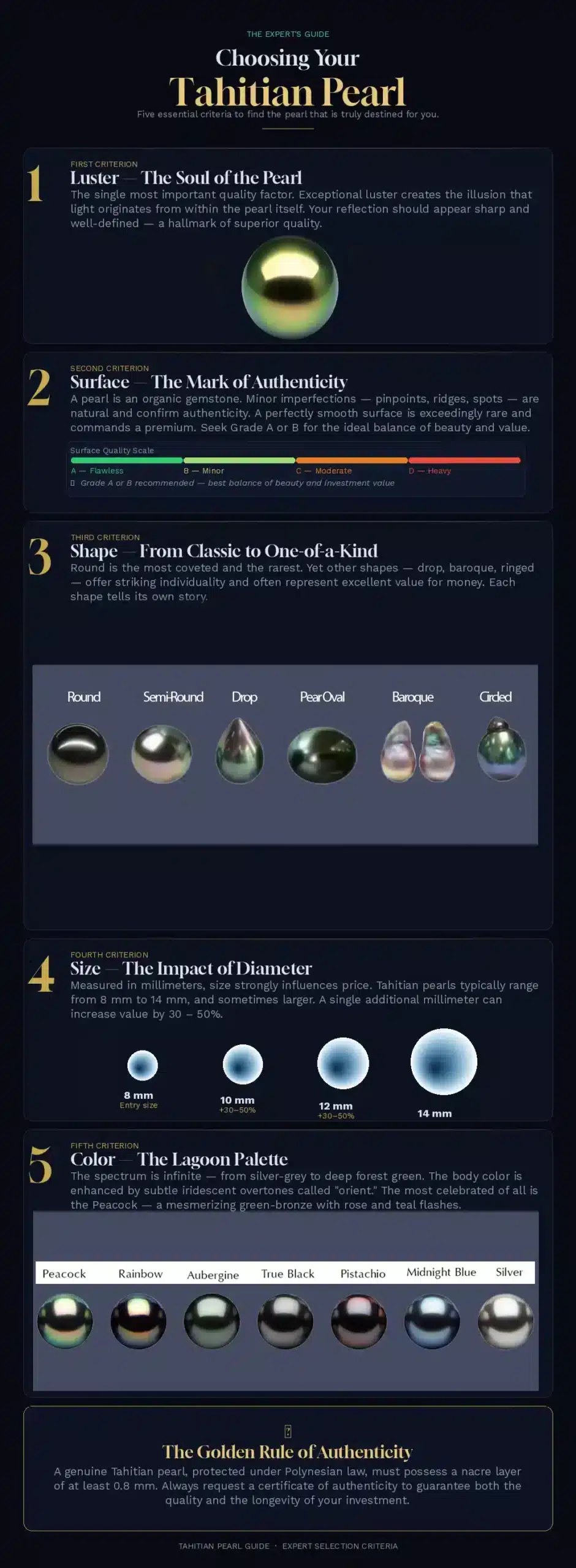
1. Luster
Luster is the quality of the light reflected by the pearl. A high-quality pearl has a deep, mirror-like glow, and the reflection should stay sharp. A dull or chalky pearl has weak luster. This is the number one beauty criterion and one of the best indicators of overall quality.
2. Surface quality and grade
A pearl is an organic gem. Small surface characteristics such as tiny pits or fine lines are normal and can be signs of authenticity. A perfectly smooth surface is rare and expensive. The French Polynesian Marine Resources Department uses a grading scale from A to D based on the extent of surface imperfections.
- Grade A: imperfections on less than 10% of the surface, excellent luster.
- Grade B: imperfections on less than 30% of the surface, excellent value for everyday wear.
- Grade C: imperfections on less than 60% of the surface, more accessible price point.
- Grade D: more visible imperfections on over 60% of the surface.
Practical note: a Grade B baroque pearl with beautiful luster can be far more appealing than a Grade A round pearl with weak brilliance. Grade alone never tells the full story.
3. Shape
- Round: the most classic and the most sought-after shape.
- Semi-round: slightly flattened, elegant, and often more affordable.
- Drop: ideal when you want movement and a softer silhouette.
- Circled: marked by concentric rings, a natural signature many collectors appreciate.
- Baroque: freeform and asymmetrical, each piece is one of a kind.
4. Size
Tahitian pearls usually range from 8 to 14 mm. Even a 1 mm increase can raise the price significantly because larger pearls are rarer.
- 8 to 9 mm: understated, ideal for a first purchase.
- 9 to 10 mm: the most versatile and common range.
- 10 to 12 mm: more visual presence.
- Over 12 mm: rarer and more exceptional pearls.
5. Color and overtones
The base color can range from gray to black, with green, bronze, or aubergine nuances. On top of that come the overtones, sometimes called orient. The best-known is “peacock,” a mix of green, rose, and violet. There is no universally “best” color – it all comes down to taste and the emotion the pearl creates.
Which pearl color works best with your skin tone?
These are useful guidelines, not strict rules. The most important thing is that the pearl feels right to the person who will wear it.
- Fair skin: silver, lavender, or rosy overtones often bring light and softness.
- Medium or golden skin: warmer colors such as peacock, bronze, or deep green often create a striking contrast.
- Dark skin: almost every color can work beautifully, especially green and peacock overtones.
Tip for buying online: ask for a photo of the pearl against skin, such as on the hand or wrist, or in different lighting conditions. A reputable seller should be able to guide you.
How to read the price of a Tahitian pearl necklace
The price of a Tahitian pearl necklace can look opaque at first. In reality, it follows a fairly clear logic once you know what to look for. Several factors directly affect the value of the piece.
- Luster: this is the top driver. Two pearls of the same size can show a major price gap if one has exceptional luster and the other only average luster.
- Shape: a perfectly round pearl generally costs more than a semi-round or baroque pearl.
- Size: once you go above 11 mm, every half millimeter starts to matter more.
- Color: highly sought-after tones such as peacock or deep green can command a premium.
- Surface grade: with equal luster, a Grade A pearl will cost more than a Grade B pearl.
As a general guide, here are some price ranges we see in our workshop for quality necklaces with good to excellent luster.
- Single pearl pendant, 9 to 10 mm pearl, Grade B, leather mounting: 12,000 to 18,000 XPF, about $100 to $150 USD.
- Single pearl pendant, 10 to 11 mm pearl, Grade A, silver mounting: 25,000 to 40,000 XPF, about $210 to $335 USD.
- Pearl strand, 18-inch length, 9 to 10 mm pearls, Grade B, even quality: 70,000 to 120,000 XPF, about $590 to $1,000 USD.
- Pearl strand, 18-inch length, 10 to 11 mm pearls, Grade A, mirror luster: 150,000 to 300,000 XPF, about $1,250 to $2,500 USD.
These prices include artisan mounting and proof of origin. A suspiciously low price should raise questions. Either the pearls are low quality, or they are not genuine Tahitian pearls.
Simple rule: always ask for the grade, the origin, and, if possible, a photo in natural light. A transparent seller should have no issue providing that information.
Styles and mountings: finding the necklace that suits you
Main necklace styles
- Single pearl pendant: one pearl on a fine chain. Ideal for highlighting a beautiful pearl. Browse our Tahitian pearl pendants.
- Leather cord necklace: a more relaxed style, durable, and often ideal for everyday wear.
- Pearl strand: several pearls strung together, a more classic and precious option. Discover pearl strands.
- Mountings with local materials: mother-of-pearl, wood, or shell for more distinctive pieces.
Leather, silver, or gold: what should you choose?
- Leather: more casual and comfortable for daily wear. Best kept away from water.
- Silver: rhodium-plated silver helps limit tarnish and stays easy to wear.
- 18k gold: durable and timeless. Yellow or rose gold warms the pearl, while white gold highlights cooler tones.
What necklace length should you choose?
- Choker, 14 to 16 inches: sits close to the neck and highlights the neckline.
- Princess, 16.5 to 18 inches: falls just below the collarbone and remains the most versatile length.
- Sautoir, 27 inches and up: elongates the silhouette and can sometimes be worn doubled.
Practical tip: before ordering, take a piece of string, place it around your neck at the desired length, and measure it. It is simple and reliable.
Authenticity: how to avoid unpleasant surprises
Signs of a real Tahitian pearl
- Touch and weight: a genuine pearl feels cool to the touch and has noticeable weight.
- Surface: small natural irregularities are normal. A perfectly flawless sphere should prompt a closer look.
- Light test: if the nucleus shows very clearly under a strong light, the nacre layer may be too thin.
Certificate of authenticity
It is not legally required for retail sales, but it is strongly recommended for a significant purchase. A reliable certificate should mention Polynesian origin, the nature of the pearl, its size, shape, color, and grade. If no certificate is provided, a detailed invoice is the minimum you should expect.
Caring for your necklace so it lasts
- Avoid: perfume, hairspray, chemicals, chlorine, salt water, and acidic liquids.
- Best habits: put your necklace on last, remove it first, then wipe it gently with a soft, slightly damp cloth after wearing it.
- Storage: keep it separate from other jewelry, ideally in a pouch.
The secret: wear your pearl regularly. The natural warmth of the skin helps preserve its glow.
Why buy your necklace from Ventanou in Haapiti
Ventanou is a workshop based in Haapiti, on the island of Moorea. We work directly with two family pearl farms, in the Gambier Islands and Bora Bora, as well as with local artisans for the mounting. Our selection favors the character of each pearl – its color, shape, and luster – rather than an industrial standard.
- Traceability: known origin, monitored mounting.
- Short supply chain: no unnecessary middlemen.
- Support: follow-up from Haapiti and availability after purchase.
- Secure shipping: tracked and insured delivery.
About this guide: it was prepared by the Ventanou team, in daily contact with pearl farmers and artisans from Moorea, the Gambier Islands, and Bora Bora.
Frequently asked questions
What is the difference between a Tahitian pearl and a freshwater pearl?
A Tahitian pearl is a marine pearl cultivated one at a time in the oyster Pinctada margaritifera. Its nacre is thick and its luster deep. A freshwater pearl is grown in rivers or lakes, often with multiple pearls per mussel, and its glow is usually softer.
Can the color of a Tahitian pearl change over time?
The natural color remains stable. However, the luster can become dull if the pearl is exposed to perfume, hairspray, or poor care habits.
Can you swim with a Tahitian pearl necklace?
No. Salt water, chlorine, and shower products can damage the surface of the pearl and weaken the mounting thread.
Why do some pearls have rings?
These are circled pearls. The rings are natural growth marks and part of their character. They are not automatically considered flaws.
Is a certificate of authenticity required?
No, it is not legally required for retail sales. In French Polynesia, only approved jewelry businesses can issue an official certificate of authenticity.
For a purchase from an artisan or a small workshop like ours, the detailed invoice is the key document. It should mention Polynesian origin, the nature of the pearls, their main characteristics such as size, shape, and quality, as well as the mounting.
At Ventanou, every order comes with an invoice listing these details, and we provide a certificate for the most important pieces when relevant.