





A Powerful Expression Carved in Volcanic Stone
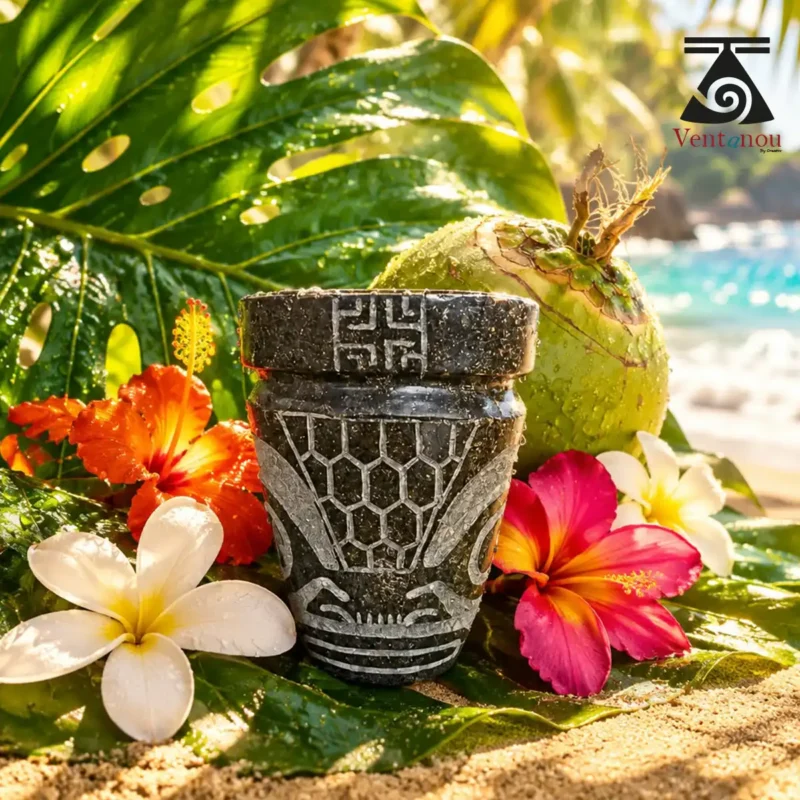
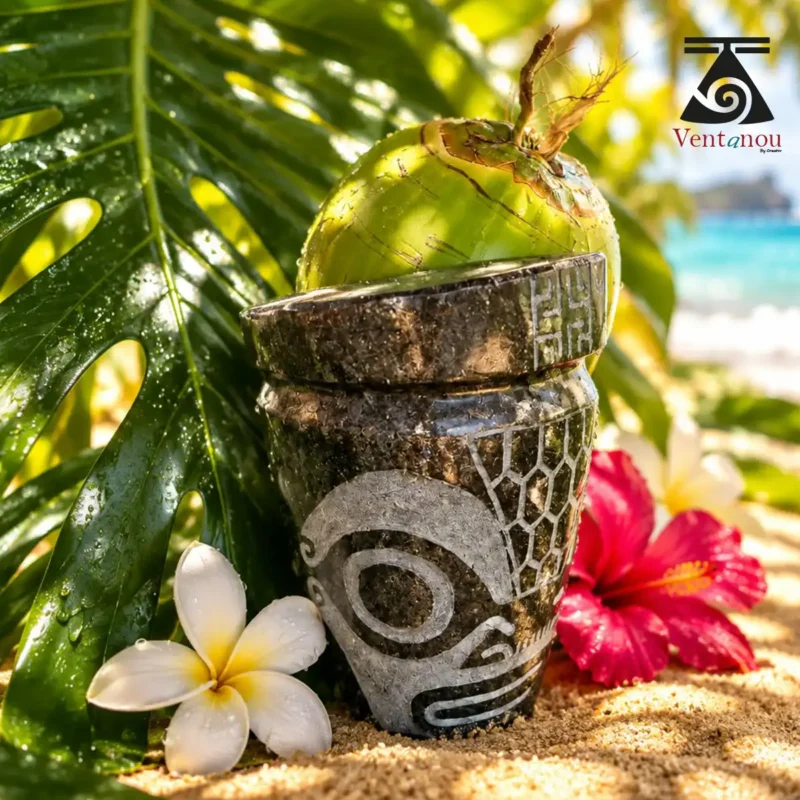
Some sculptures command attention through their size. Others achieve it through the strength of their design. Standing just under five inches tall, this basalt tiki head draws the eye with its stylized facial features, intricate engravings, and the contrast between dark volcanic stone and lighter carved details.
The rounded head features prominent eyes, a carefully defined mouth, and geometric patterns that extend across its surface. Every change in depth contributes to the sculpture’s expression, revealing details that become more apparent when viewed from different angles.
Unlike a full-body tiki statue, this carved Polynesian tiki head concentrates its visual character in the face and surrounding ornamentation. Its compact proportions make it particularly suited to close observation, where the texture of the stone and the precision of the carving can be fully appreciated.
The Marquesan Cross: A Cultural Motif with Human Roots
Among the details featured on this sculpture is the Marquesan cross, known as peka ‘enana, a recognizable element of the artistic traditions of the Marquesas Islands.
Its distinctive geometry incorporates a stylized human representation, reflecting the importance of human figures within Marquesan visual culture. Similar artistic principles can be found across different forms of Marquesan expression, including woodcarving, stone carving, and tattooing.
The Marquesan cross is sometimes associated with harmony and balance in contemporary interpretations. However, its cultural significance cannot be reduced to a single universal meaning, and the particular intention behind its inclusion in this artwork has not been documented.
Set into the volcanic stone, the motif adds another dimension to the sculpture’s design, bringing together geometric ornamentation and the expressive qualities of the tiki.
Family, Ancestry, and the Human Figure in Polynesian Art
Alongside the Marquesan cross, the sculpture incorporates a motif identified as representing family. Its presence introduces a theme closely connected to Polynesian cultural life: the relationships between individuals, their relatives, and the generations that came before them.
Family connections and ancestry hold an important place in many Polynesian societies, although the visual expressions of these relationships differ between island groups and artistic traditions.
The tiki itself belongs to a much broader history of human representation in the Pacific. Depending on the cultural context, carved figures may be associated with ancestors, important individuals, or other subjects within local traditions.
Across the many forms of Polynesian tiki sculptures in wood and stone, the treatment of facial features, materials, and ornamentation can vary considerably. This particular work combines a compact stone head with engraved designs that give it a distinct artistic identity.
The family motif is presented here according to its identification for this artwork, without assigning it an undocumented ritual meaning or specific spiritual power.
Basalt from French Polynesia’s Leeward Islands
Basalt is a volcanic rock formed as lava cools and solidifies. Its presence throughout French Polynesia reflects the volcanic origins of many of the islands, whose dramatic mountains and rugged landscapes are part of the region’s identity.
The stone used for this sculpture comes from the Leeward Islands, within the Society Islands archipelago. Its dark tones provide a striking background for the carved features, while its dense mineral character gives the finished piece a substantial weight.
At 2.76 pounds, this volcanic stone tiki sculpture feels remarkably solid for its dimensions. Its rounded surfaces contrast with the recessed lines and detailed ornamentation, emphasizing the craftsmanship involved in working the basalt.
The distinction between the material and the artwork’s cultural references is important: the stone originates in the Leeward Islands, while the Marquesan cross belongs to the artistic heritage of another Polynesian archipelago.
A Distinctive Addition to a Polynesian Art Collection
With its expressive face and intricately worked surface, this tiki head offers a different presence from larger freestanding statues. It can be displayed on a shelf, in a glass cabinet, or alongside other original works from the Pacific Islands.
A simple background helps bring out the dark basalt and its lighter engraved details. Gentle lighting from the side reveals the depth of the carving, making the facial features and geometric designs easier to appreciate.
For collectors drawn to Polynesian volcanic stone sculpture, this piece brings together an expressive human form, distinctive carved motifs, and the character of basalt from French Polynesia.
Its appeal lies in the combination of material, artistic detail, and cultural references, making it an original work to appreciate for both its craftsmanship and its individuality.
Artwork Specifications
- Artwork: stone carved Polynesian tiki head
- Material: volcanic basalt from the Leeward Islands
- Motifs: Marquesan cross and family symbol
- Decoration: engraved geometric patterns and carved facial features
- Height: 12.5 cm (4.92 in)
- Width: 8 cm (3.15 in)
- Depth: 9 cm (3.54 in)
- Weight: 1.250 kg (2.76 lb)


Reviews
There are no reviews yet.